
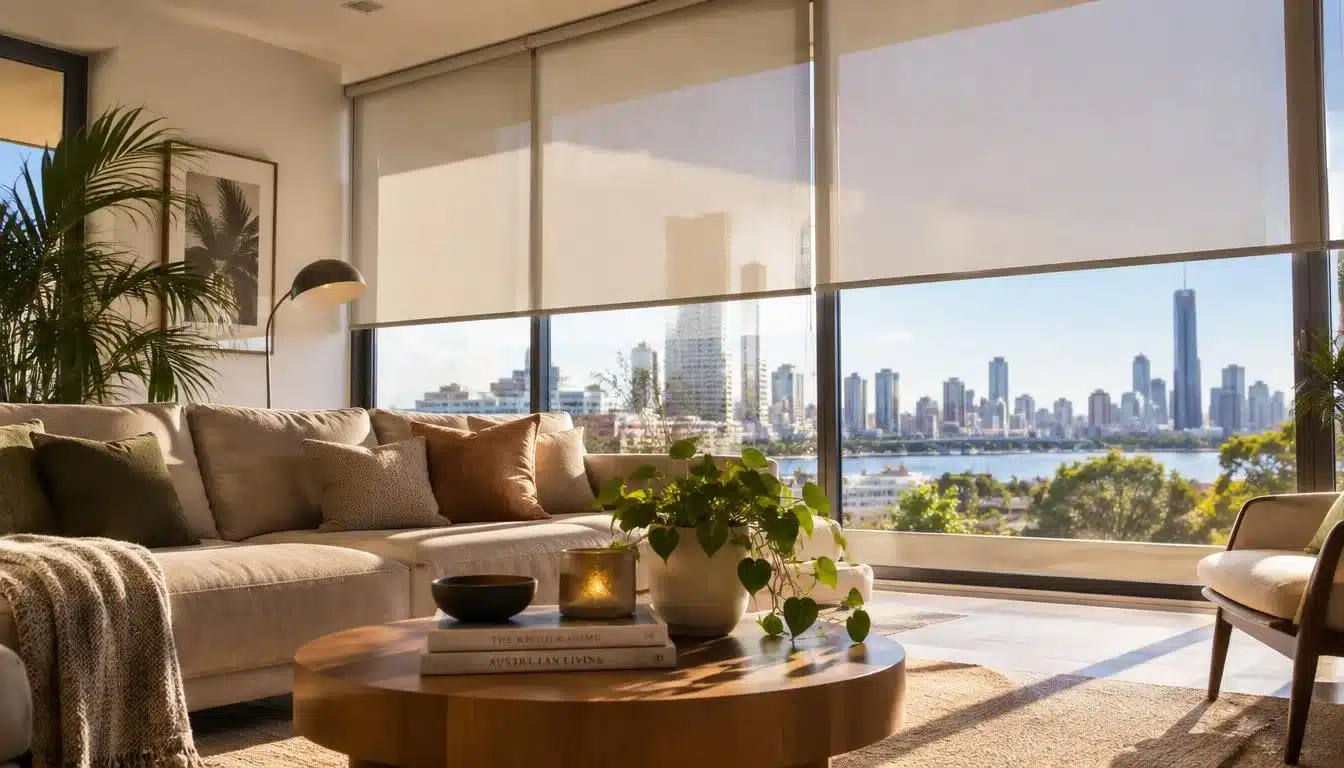
Smart, Sleek, and Sun-Safe: Top Window Blind Trends Coming in 2027
2027 trends in residential blinds Brisbane and SEQ: practical roller blinds stay popular as smart homes boost demand for motorised blinds. Shop yours now.
By 3pm on a Logan summer afternoon, a west-facing lounge room can feel like an oven, even with the air con running. The sun hits the glass low and hard, and the heat builds on the couch, the floor and the walls. The right residential blinds stop that sun before it settles into the room.
Our Logan family team makes every blind here in Logan, QLD. We are a local, family-owned business, and we know what a Queensland summer does to a home. We work with four styles: vertical, panel glide, Venetian and roller blinds.
Each one suits a different kind of window and a different way of using a room. By the end, you will be able to match a style to each room and know what to ask before you order. The first step is seeing how the four styles differ, and which one each window really needs.
The best residential blinds for summer are the ones that match how each window takes the sun. A blind on a shady south window has an easy job. A blind on a west window facing the 4pm sun needs to work much harder.
Four things decide the right pick. Window orientation comes first, then the size of the window and how you use the room. The last question is whether you need privacy as well as shade.
West and north-facing windows take the most heat in Queensland. These are the windows to plan first, and they often need a stronger fabric or a style that closes fully. East windows get the morning sun, which matters most in bedrooms.
A common mistake is choosing blinds on colour alone. A lovely shade means little if the blind is awkward to open on a door you use 30 times a day. Think about how the blind moves before you think about how it looks.
Pick the operation style first and the colour second. A blind that suits how you use the window will serve your home for years.
Quality matters too, because cheap tracks and thin fabric wear out fast in strong sun. Our guide on how to pick the perfect blinds for your home covers room use and light control in more detail. Once you know what each window faces, you can compare the four styles side by side.
A single style rarely suits every window in a house. Most homes end up with two or three styles, chosen window by window. Our range covers vertical, panel glide, Venetian and roller blinds, so you have options for every opening.
A panel glide blind is a set of flat fabric panels that slide along a multi-track rail and stack neatly to one side, much like a sliding door. The other three styles work with slats or a single roll of fabric. Here is how they compare.

| Style | How it opens | Best window type | Light control |
|---|---|---|---|
| Vertical | Rotating slats on a top track | Sliding doors | Adjustable tilt |
| Panel glide | Sliding panels | Wide openings and patio doors | Panels stack to one side |
| Venetian | Horizontal slats lift up | Standard windows | Precise tilt |
| Roller | Fabric rolls onto a tube | Most windows | Depends on the fabric |
Wide doors and big openings suit styles that move sideways. Verticals and panel glides both draw across, so you can walk through without lifting anything. Panel glides give a flatter, more modern look, while verticals let you tilt the slats for light.
Avoid Venetians on doors in constant use. You would need to raise the whole blind every time someone steps outside, and the slats bend easily when bumped. On a busy back door, that gets old within a week.
Standard windows suit roller blinds and Venetian blinds best. Rollers give a clean, simple face and sit neatly in the window recess. Venetians let you tilt slats to fine-tune light through the day.
Sometimes two styles fit the same window equally well. In that case, look at how often you will adjust it and what the rest of the room uses. Matching the style in one room keeps the look tidy, and the roller is usually the simplest place to start.
Picture a bedroom facing east, where the sun hits the bed at 5:30am in January. A roller blind in blockout fabric keeps that room dark until your alarm goes off. That is why roller blinds are the go-to choice for so many bedrooms.
Rollers suit so many rooms because of their minimal look. When pulled up, the fabric sits on a slim tube at the top of the window. When pulled down, you get one flat, smooth face with no slats or folds.
A roller sits neatly inside the window recess, which gives a built-in finish. This design keeps the frame and sill on show, so the window still looks like part of the room. It also leaves less gap for light to sneak around the edges.
The fabrics you choose change how each roller works. Blockout fabric suits bedrooms and nurseries where sleep matters most. Light-filtering fabric suits living areas, softening the glare while keeping the room bright.
A common mistake is putting a single blockout roller in a living room. It cuts the heat, but the room feels dark all day unless you pull it up. If you want to adjust light without lifting the whole blind, a slatted style suits better.
Venetian blinds suit you if you adjust the light in a room several times a day. A quick tilt of the slats changes the light in seconds, without raising the blind. That makes them handy in rooms where the sun moves across the window.
Tilting the slats lets in light while blocking direct glare. Angle them upward and you get soft daylight on the ceiling, not a harsh beam on your desk. Close them fully when you need full privacy.
Venetians work well in these rooms:
Timber and aluminium Venetians are both common materials. Timber gives a warm, natural design that suits lounges and bedrooms. Aluminium is light, tough and easy to wipe, which makes it the better pick near water and cooking.
Good quality Venetians have slats that sit level and a tilt that holds its angle. Cheap slats can sag in the Queensland heat after a few summers. For a sliding door, though, a style that draws sideways makes more sense.
Think of a family walking in and out of a sliding door all day, with kids, dogs and washing baskets. Vertical blinds handle that traffic well because they draw aside rather than lift up. You pull the slats back once and the doorway stays clear.
Verticals suit sliding doors because they can part in the middle or stack to one side. You choose the split to match how the door opens. A centre split suits double doors, while a side stack suits a single slider.
The slats rotate to control light, so you can shade the room without closing it off. Turn them partway and you keep the view of the yard while cutting the glare. Close them fully for privacy at night.
Vertical blinds also suit tall windows, such as those in a stairwell or a raked ceiling space. The long slats follow the height of the window and draw a strong upward line. That can make a room feel taller.
There is one exception. On a very wide modern opening, panel glides look cleaner than many narrow slats. If your window runs across most of the wall, a flatter style may suit your home better.
Panel glide blinds are the tidiest choice for openings over a few metres wide. The broad panels slide across on their tracks and stack to one side when open. You get a neat, calm look even on the biggest stretch of glass.
Because the panels stack to one side, most of the opening stays clear. That matters on a patio door, where you want easy access to the deck. It also keeps the view open when you are not using the blind.
Panel glides work well in these spots:
Each panel is a large flat surface, so it shows the fabric pattern well. A bold print or a soft texture reads clearly, rather than being broken up by folds or slats. That makes panel glides a strong design choice for a feature wall.
The look is modern and simple, much like a sliding screen. Now that you know all four styles, you can start picking the right one for each room.
Most homes mix styles, and that is normal. You might put blockout rollers in the bedrooms, panel glides on the patio door and aluminium Venetians in the bathroom. Each room gets the blind that suits its job, and the house still looks tidy.
The trick is to start with each room’s main need. Sleep, privacy, glare and easy cleaning all point to different choices. Here is a quick guide.
| Room | Main need | Suggested style | Fabric |
|---|---|---|---|
| Bedroom | Sleep | Roller | Blockout |
| Living room | Glare without darkness | Panel glide or vertical | Light-filtering |
| Kitchen | Easy to wipe | Aluminium Venetian | None |
| Bathroom | Privacy and moisture | Aluminium Venetian | None |
| Home office | Screen glare | Venetian or roller | Light-filtering |
Bedrooms and nurseries need darkness first. A blockout roller lets kids nap at 1pm and keeps early summer sun off your face. Fit it inside the recess for the snuggest edge.
Living and dining areas need shade without gloom. Panel glides or verticals in light-filtering fabric take the edge off the glare while the space stays bright. The guide on choosing blinds by room has more ideas for open-plan spaces.
Kitchens, bathrooms and laundries face steam, splashes and grease. Aluminium Venetians handle all three and wipe clean in a minute. Their quality and style hold up well in damp rooms, so choosing the fabric matters most everywhere else.
The fabric does most of the heat work in a roller or panel glide blind. The tube, track and chain only hold it in place. So the fabric you choose decides how a room feels on a 35-degree afternoon.
Blockout fabric stops light passing through. It suits bedrooms, nurseries and media rooms, where you want darkness at any hour. A blockout blind on a TV room window also stops the screen washing out in the afternoon.
Light-filtering fabric softens light rather than stopping it. It suits daytime living spaces, where you want shade and glare control but still need to see. Many people choose it for lounges, kitchens and home offices.
Fabric quality matters as much as the type. Thicker weaves hold their shape and colour longer under strong Queensland sun. The colour of the fabric also changes how bright the room feels.
The best way to choose is to order samples before you decide. Hold each one up to your actual window at the time of day the sun hits hardest. You will see the difference far better than on a screen, and it can help you weigh blinds against curtains too.
A classy look comes from fit, not from the category of window covering. A blind that fits the recess well looks smarter than a curtain that drags on the floor. The reverse is true too.
Curtains or blinds, which is more classy? Neither, since the class comes from fit and fabric. A well-made blind or curtain in a good fabric will always look polished.
Blinds give a crisp, tailored line. They sit close to the glass and keep the window frame tidy. That suits modern homes, small rooms and spaces where furniture sits near the window.
Curtains add softness and texture. They frame a window and can make a room feel warmer and more relaxed. They also take up more space at the sides of the window.
You do not have to choose only one. Layering sheers over blinds works well, giving you the soft look of curtains with the light control of a blind. Many people layer window furnishings this way in living rooms, where the blind does the heat work and the sheer adds style. Once you pick your covering, colour is the next decision.
Imagine a room with white walls and charcoal roller blinds. The dark blinds stand out sharply and frame each window like a picture. That is a bold choice, and it shows how much colour changes a room.
Your blinds should be lighter or darker than your walls depending on the effect you want. Usually, a shade lighter or a matching colour helps them blend in. Go darker if you want the blinds to make a feature.
These colour choices suit most homes:
Pale fabrics reflect more summer sun. They bounce some light back out, while dark colours tend to soak it up. On a west-facing window, a lighter colour is often the cooler style choice.
Think about the whole room too, including floors, cushions and benchtops. A colour that suits the room’s design will still look right in five years. With colour sorted, the next thing to plan is price.
Roller blinds and aluminium Venetians are usually the entry point on price.
Size, Style and Fabric
Size has the biggest effect on price, since a large window needs more fabric or slats. Style comes next, with panel glides and timber Venetians costing more than rollers. Blockout and textured fabrics can add to the product price too.
For a whole house, count every window and price each one on its own. Two windows of different sizes will not cost the same, even in the same style. Put rollers where they work and spend more on the windows you look at most. Where your money goes also matters.
Picture an imported blind arriving after weeks at sea, only to be 2cm too narrow for your window. Sending it back means another long wait in the hottest part of summer. A blind made locally avoids most of that trouble.
Our Logan family team makes every blind in Logan, QLD. We are a local, family-owned business, so you deal with the people who build your products. If something needs a tweak, we are only a short drive away.
Buying from a local maker brings real benefits:
Local makers in this industry also see how their blinds hold up in local weather. That feedback shapes the fabrics and fittings they choose. The result is quality products made for heat, humidity and storms.
Lead times still depend on the style and how busy the season is. Ask any company you talk to how long your order will take. That question is a good start when you check a supplier.
Warranty and installer reviews tell you the most about a blind supplier. The warranty shows how long the company stands behind its work. Reviews show how the fitting and after-sales service really went for other customers.
Warranties on blinds in Australia commonly range from 2 to 5 years. Ask how long the warranty runs and what it covers. Some cover fabric and parts, while others also cover the fitting.
When you read residential blinds reviews, look past the star rating. Find comments about the installer, the clean-up and how the team handled a problem. A customer who says they highly recommend the service after a fix is worth more than a vague five stars.
Ask how many years the business has worked in the industry. Long experience usually means the team has seen most window shapes and problems. It also suggests they will still be around if you need help later.
Check whether the same team measures and installs. When one crew does both jobs, fewer details get lost along the way. You also know exactly who to call if a blind does not sit right, which makes ordering much simpler.
Say you book a measure and quote for Saturday morning. A measurer arrives with fabric samples, checks every window and talks through your rooms over a cuppa. By lunchtime, you have a clear quote and a plan.
Finding residential blinds near you in Logan means a short trip for the measurer. That makes it easy to fit a visit around your weekend. It also means the team can return quickly if a window needs a second look.
Here is how ordering works, step by step:
A common mistake is measuring yourself for recess fits. A recess blind must fit within a few millimetres, and windows are rarely perfectly square. One wrong number can leave a gap or a blind that will not fit at all.
When our team comes to install blinds, they check each one opens, closes and sits level. The installation usually takes a few hours for a typical home, depending on how many windows you have. After that, a little care keeps your blinds working well.
Summer is when dust and bugs build up fastest on blinds. Open windows, fans and storms all bring in fine dirt that settles on slats and fabric. A quick clean every 2-4 weeks keeps your coverings looking fresh.
Each style needs a slightly different routine. Use the right tool and avoid the few things that cause damage. Here is a simple guide.
| Style | Routine clean | What to avoid |
|---|---|---|
| Venetian | Duster or damp cloth | Soaking timber slats |
| Roller | Light vacuum | Harsh sprays |
| Vertical | Wipe the slats | Tangling the chain |
| Panel glide | Vacuum the panels | Forcing the track |
Roller blinds clean best with a soft brush attachment on low suction. Work from the top down so dust falls onto parts you have not cleaned yet. Spot clean marks with a damp cloth rather than a spray.
Keep cords and chains out of children’s reach at all times. Use the cleats or tensioners fitted with your blinds to hold cords tight against the wall. This is the most important safety step in any home with young kids.
Always keep blind cords and chains tied up and out of children’s reach. A cleat or tensioner takes seconds to use and keeps kids safe.
Good care is one of the simplest solutions for longer-lasting blinds. With the right routine, they will keep working through many summers. All that remains is choosing yours.
The best time to sort your blinds is before the hottest weeks of summer arrive. Match the style to the window and the fabric to the room, and your home will stay cooler and look better. That one rule covers most decisions.
Our range focuses on vertical, panel glide, Venetian and roller blinds. We do not make shutters, plantation styles, awnings or roman blinds. That focus lets us put all our care into the window furnishings we know best.
Your next step is easy. Call our Logan family team on 3299 3055 to book a free measure and quote at your home.


———- CONTACT INFORMATION
Phone:
07 3299 3055

———- BUSINESS HOURS
———- OUR LOCATION